

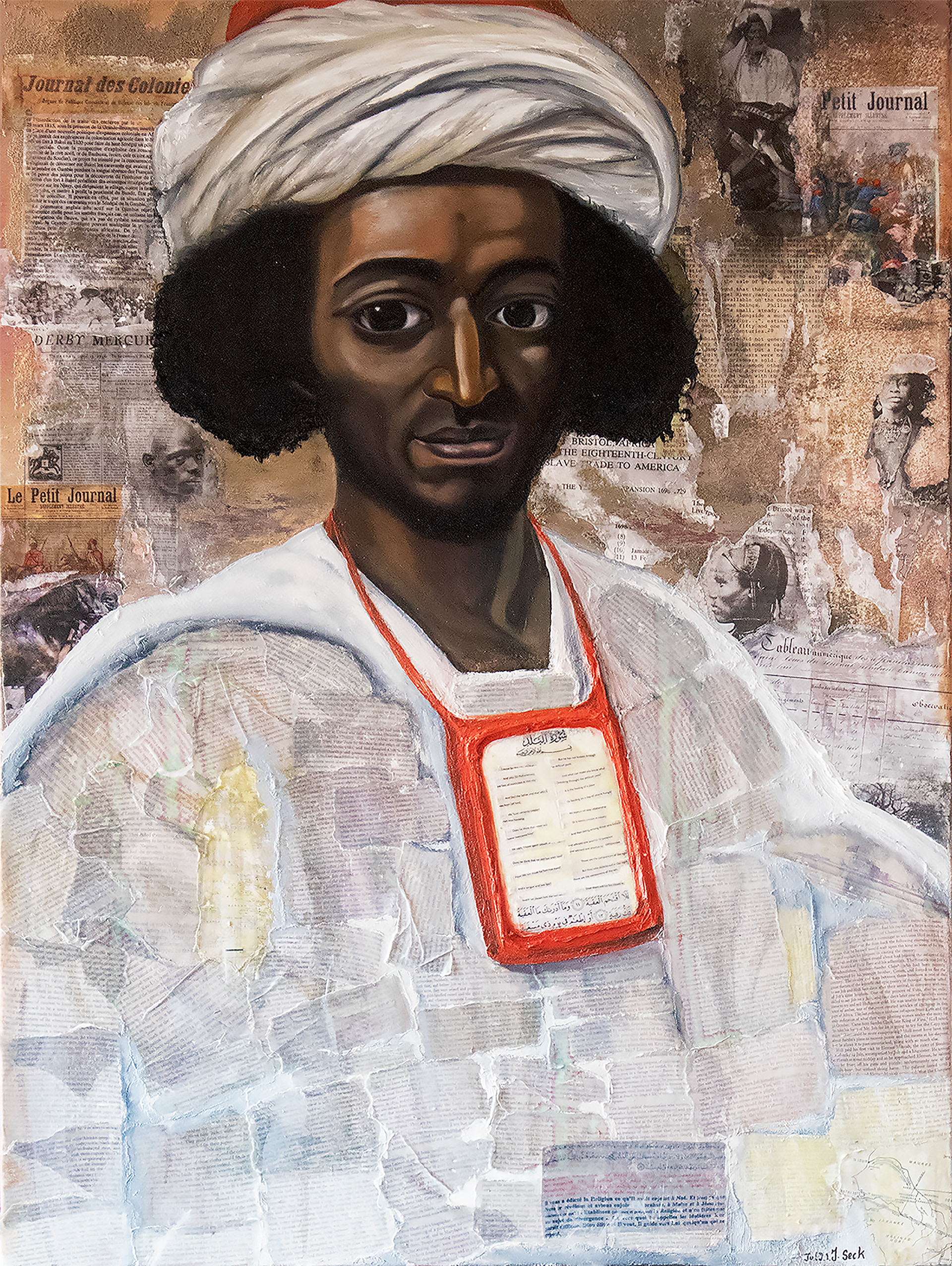
Job Ben Solomon is the name he went by in Europe, but long story short, the portrait above is Ayuba Suleiman Diallo, son of a Senegambian "Thierno," the Pulaar title for a local Islamic scholar, equivalent to an Arabic Sheikh.
Job’s story exposes how individual destinies were caught in the gears of global commerce.
His introduction to British officials came about under rather unusual circumstances.
Ayuba was sent by his father, Suleiman, to sell two enslaved people along the Gambia River to a Captain Pike. When they couldn't agree on a price, Ayuba ignored his father's instructions, crossed the river into enemy territory, and sold them for a better deal. On the return trip, he and his interpreter, Lamine Ndiaye, used the proceeds to buy cattle and stopped in a nearby village for lunch.
There, they were ambushed by a Mandingo group, shaved, and sold to the very same Captain Pike, who failed to recognize his former sellers. In a striking twist of irony, Ayuba (Job) was a Fulani (Pulaar), and the enslaved people he sold were Mandingo, just like the group that captured and sold him in return.
Does that ring a bell?
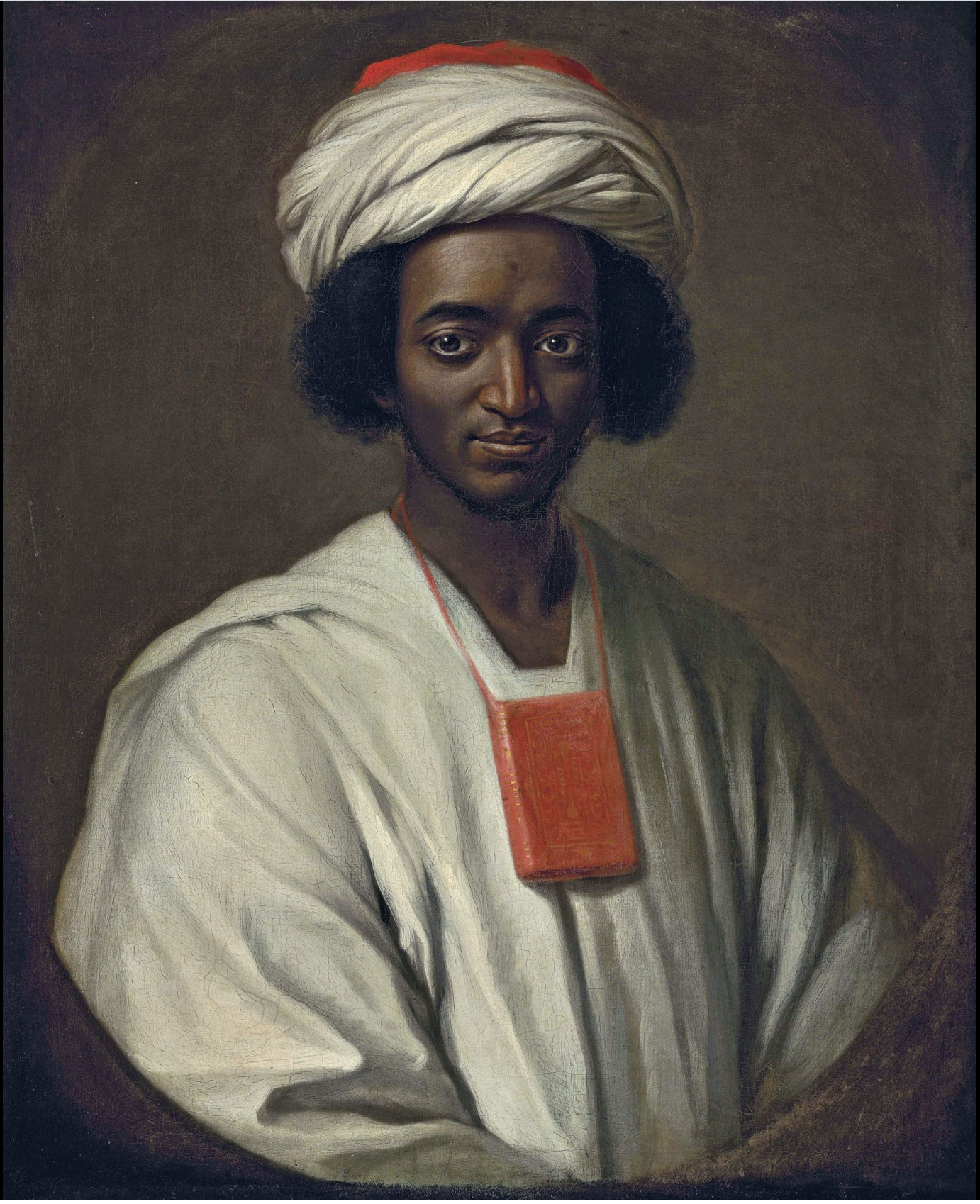
The painting below is the original portrait of Job by William Hoare, painted in 1733 and commissioned by Sir Hans Sloane. Today, it resides in the National Portrait Gallery collection at Trafalgar Square in London.
I initiated the concept of Doc'Art painting to revisit historical, social, political, or cultural topics through personas and objects relevant to each theme.
Using mixed media, such as oil paint, acrylic, resin, stucco, and newspaper collage, I capture specific snapshots in time (typically spanning roughly a century) in an effort to contribute to the historical literature through visual art.
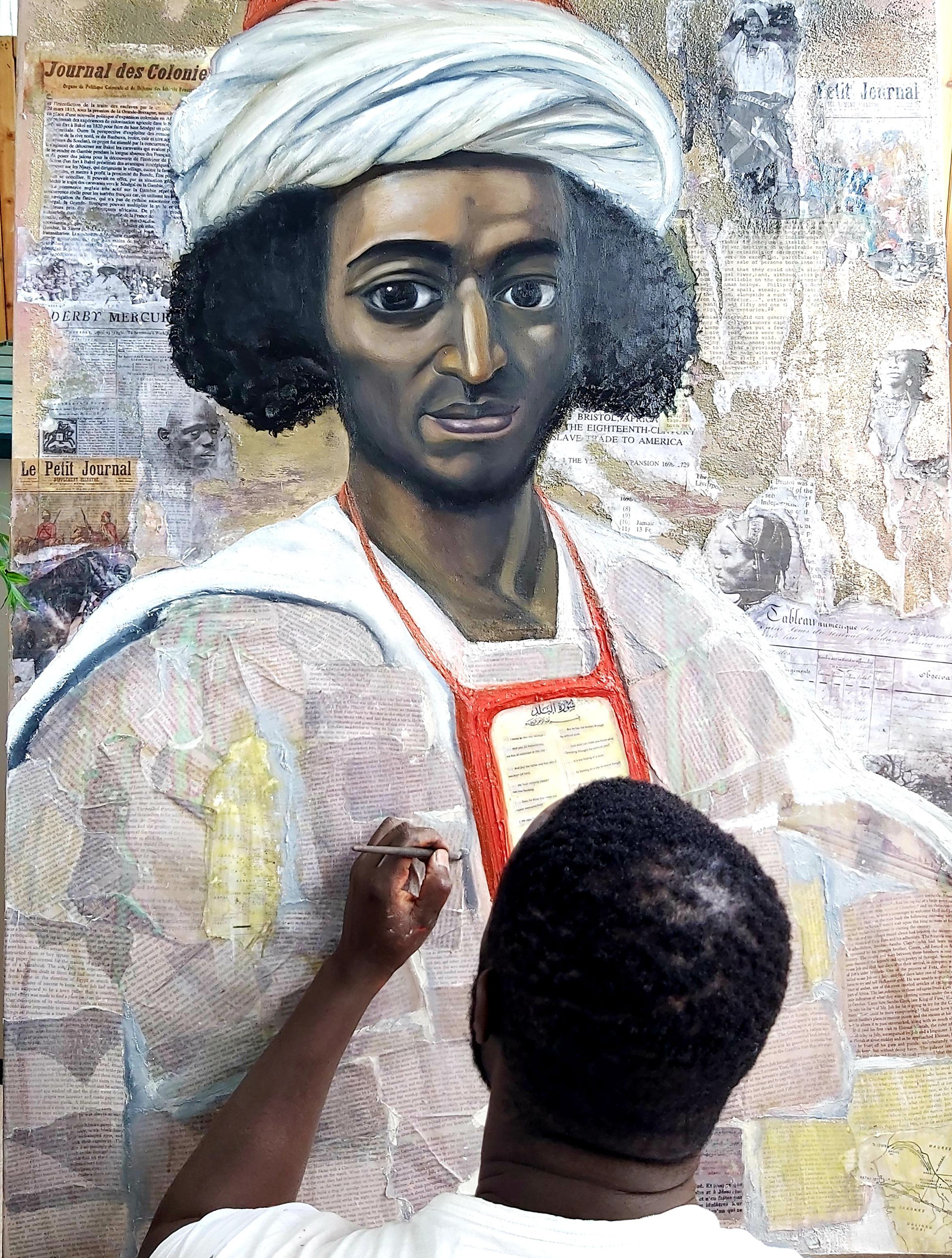
My interest in Job's story lies in how it sheds light on the transatlantic slave trade while indirectly revealing the mechanics of the trans-Saharan trade. Job’s narrative shows that for a solid thousand years, African economies were largely dictated by trade with foreign powers.
First came the often-understated trans-Saharan trade initiated by Arab merchants, who also enslaved white European Christians and non-believers across the Mediterranean and Slavic regions. As strong nations emerged in Europe and halted that avenue, the drain on Africa intensified to meet the relentless labor demand of the Baghdad Caliphate, the Maghreb, and the Middle East. Like its European counterpart, the trans-Saharan trade was driven by thinly veiled economic motives. Most West Africans who faced religious pressure had already embraced a practical, peaceful Islam through gradual persuasion and trade with Arab-Berber merchants in ancient Ghana; well before the Almoravids brought turmoil to the region.
Portugal, long locked out of Mediterranean trade by stronger neighbors, ventured into Atlantic exploration under the patronage of Prince Henry the Navigator. Later, following the conquest of the Americas and the disastrous fallout of the Valladolid debate (at least for Africa), powerful European nations like the Netherlands, Spain, England, and France joined the fray in the 16th century, accelerating the continent's decline.
Yet, African leaders of that era cannot be exonerated either, and Job’s story illustrates this reality. That said, collusion among certain elites hardly supports the sweeping claim that "Africans sold their own people"; the general population had no say and were ultimate victims. Just as French leaders collaborating with Hitler didn't make the French people Nazis.
Job sold two of his fellow men primarily because he viewed them as heathens. Meanwhile, he willingly accepted gifts and aid from Europeans; people whose religion he would have opposed had they been African, or had he not been in such a desperate plight.
Similarly, the English gentlemen's society campaigned to buy Job's freedom and return him to Africa partly out of philanthropy, but also to use him as an agent to secure trade in the Gambia region and spy on the French. They recognized Job as a shrewd, intelligent individual, even while systematically denying basic humanity to Africans at large—a denial justified by church doctrine and state ideology to rationalize the plunder of Africa, much like the Arab traders before them.
The Mandingo who captured and sold Job likely acted out of retaliation. Traditionalists following indigenous religions had long been targeted, converted, or sold into the trans-Saharan trade by Islamic tribes. The expansion of coastal European trade offered them a chance to strike back and sell their former persecutors. Ultimately, local agriculture and commerce collapsed, replaced by a massive slave trade economy built on a single directive: sell or be sold.
My motivation to explore this theme stems from how closely this history mirrors the current reality in Mali and the broader Sahel. The names have changed—some are now labeled terrorists, others allies—and Africans continue to fight one another over imported ideologies. While the core of these spiritual messages may be fundamentally humanist, the armed groups and influential factions enforcing them rarely serve Africa's development.
Africa today, much like yesterday, remains caught in the middle: a hybrid landscape squeezed between hypocritical foreign powers, opportunistic leaders, and caught-in-the-middle populations.
Ibrahima Seck