

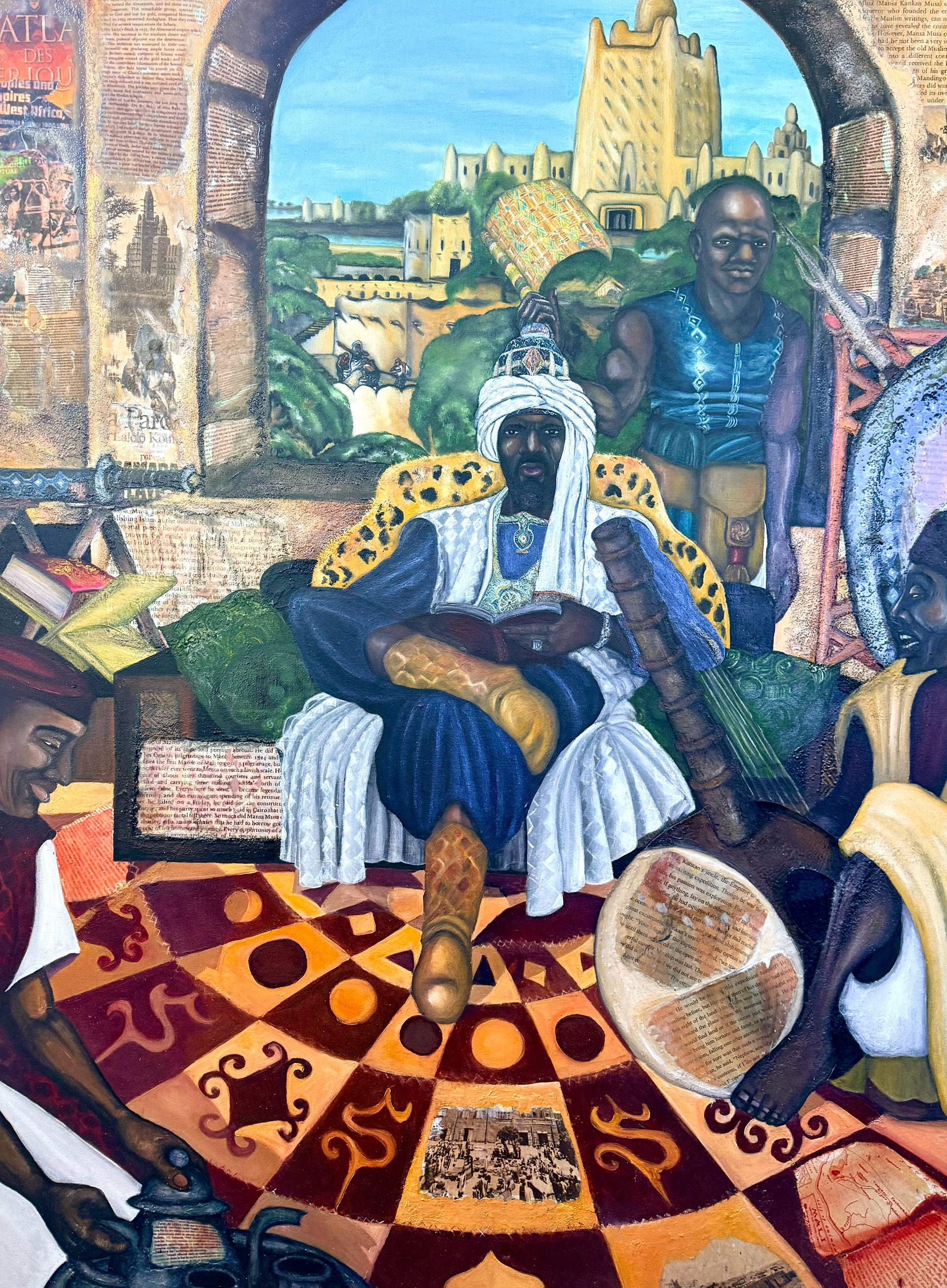
Mansa Kankan Moussa sat in Mali Empire's absolute zenith and is widely regarded by historians and economists as the richest person in recorded history, with an inflation-adjusted fortune often estimated around $400 billion. He ascended to the throne of the Mali Empire around 1312, under circumstances as dramatic as they are mysterious.
According to accounts recorded by the 14th-century Arab historian Al-Umari, Moussa’s predecessor; often identified as Mansa Abou Bakr II; abdicated the throne to embark on an oceanic voyage into the Atlantic with a massive fleet of 2,000 ships. Driven to discover what lay beyond the horizon, the fleet may have vanished into the deep ocean or reached modern day America; there is no account that confirms or infirms be above. This intriguing premise suggests an African attempt to cross the Atlantic centuries before Columbus, carrying a cultural ambition not unlike that claimed for the Vikings.
My interest in Mansa Moussa resides in the deeply controversial dimensions of his persona. To many, he was a visionary king, magnificent, pious, and generous beyond measure. To others within Africa, his actions are viewed through a more critical lens. His famous 1324 pilgrimage to Mecca; a procession of tens of thousands of attendants, soldiers, and camels heavily laden with bullion—exposed the immense wealth of the continent to the wider world. Moussa distributed and spent gold so lavishly in Cairo that he unintentionally crashed the local economy, devaluing the precious metal for over a decade. It was this unprecedented display that permanently etched Mali onto global maps, most famously on the 1375 Catalan Atlas commissioned for the King of Aragon (and later presented in European diplomatic circles), depicting Musa holding a scepter and a massive golden nugget.
Yet, behind this golden narrative lies a complex web of trans-Saharan trade that relied heavily on commodities, including a significant percentage of human lives. This economy was forged through centuries of regional upheaval. It traces back to the fall of ancient Ghana, when the Almoravids deposed the Kaya Maghan, triggering a period of deep instability. Out of that chaos rose Soumaoro Kanté, who attempted to preserve traditional ways by founding the Sosso Empire. He relied on his fierce sofa, blacksmith soldiers reputed to hold formidable magical powers, who served as the guardians of traditional totems, ancestral spiritual beliefs, and political legitimacy.
The eventual rise of Soundiata Keita (Mansa Moussa's ancestor) brings up genuine, unresolved questions regarding his relationship with the Almoravids and desert factions. Before his decisive victory at the Battle of Krina, Sundiata spent years in exile, notably at Nema (Mema) in present-day Mauritania. Upon consolidating power, he established Islam as the state religion of the new Mali Empire and codified social structures at Kouroukan Fouga (The Mande Charter). This charter laid down a social order and caste system—particularly affecting blacksmiths and descendants of Soumaoro Kanté; that continues to influence West African society to this day. It remains a rich, open field of inquiry for academics, sociologists, and historians alike.
Mansa Moussa’s story is as fascinating as it is intriguing, raising fundamental questions about power, statecraft, and memory. This idealized portrait aims to capture both the magnificence of that golden age and the intricate, bittersweet complexities beneath its surface.
Ibrahima Seck